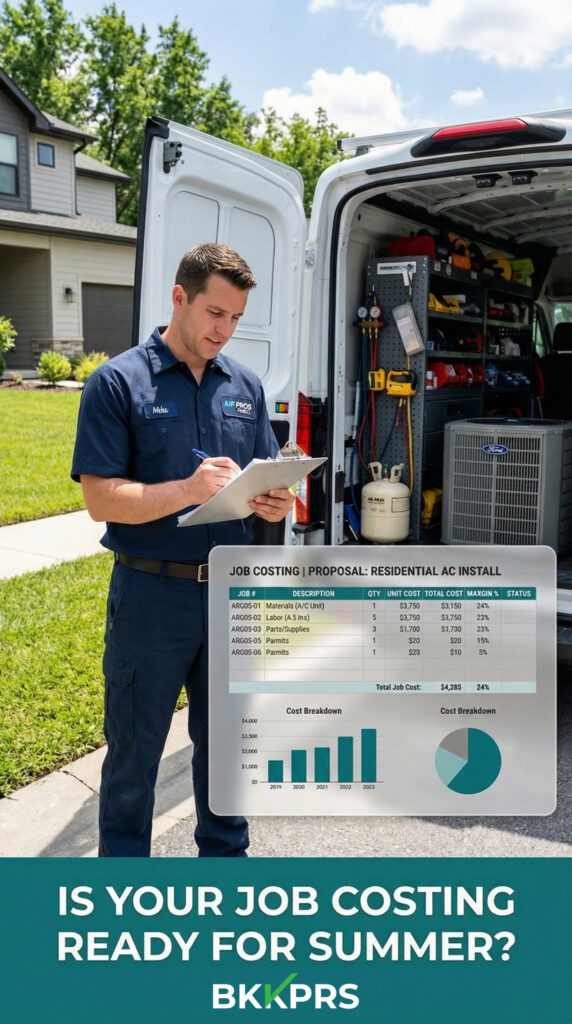
For HVAC and plumbing contractors, summer is when the phone starts ringing. But if your HVAC job costing is built on last year’s numbers, you could be closing jobs all day and still bleeding money by month-end.
Spring is the window to fix that. Before the first heat wave hits and your crew is running flat out, take the time to audit your job costing system and make sure every number reflects current reality.
Why HVAC Job Costing Breaks Down
Job costing is only as good as the inputs. Labor rates change when you give raises or add benefits. Material costs shift as suppliers adjust pricing. Overhead allocation drifts when you add a truck or lease new space. If you set up your costing model a year ago and never touched it, it is almost certainly wrong.
The industry is also shifting toward repair over replacement as homeowners defer big purchases in an uncertain economy. That means your service calls need to be priced even more precisely, because the margin on a $300 repair is very different from the margin on a $13,000 install.
Spring HVAC Job Costing Audit
Start with labor. Calculate your true loaded labor cost: base wage plus payroll taxes, benefits, workers comp, and vehicle costs. If your techs earned a raise or your insurance premiums went up, your loaded rate has changed.
Then review your materials markup. Pull actual purchase orders from Q1 and compare the prices you paid to the prices in your estimating tool. Equipment costs have risen roughly 40% since 2020, and your markup needs to reflect that.
Check overhead allocation next. Are you spreading overhead evenly across all jobs, or are you tracking it based on actual job time? An even spread can make small jobs look profitable and big jobs look unprofitable when the opposite is true.
Maintenance Agreements: Profit Center or Money Pit?
Maintenance agreements are great for recurring revenue, but only if they are priced correctly. Pull a report on every agreement you serviced in the last 12 months. What was the actual cost per visit? What did you charge? If the numbers do not work, adjust your pricing before you sell another one.
| ✅ DIY TAKEAWAY: Quick Job Costing Health Check Pull your last 10 completed jobs and answer these questions for each: 1. What was the estimated labor cost vs. actual labor cost? 2. What was the estimated material cost vs. actual material cost? 3. Was overhead allocated, or just ignored? 4. What was the actual gross margin on the job? If you find a spread of more than 15% between estimated and actual costs on more than half the jobs, your costing model needs a reset. |
The Bottom Line
In a market where the average HVAC business runs under 2% net profit, precision in job costing is not optional. The contractors running at 10 to 20% margins are not doing different work — they know their numbers better.
BKKPRS builds job costing systems from scratch for trades businesses. If your current setup is not giving you the answers you need, visit bkkprs.com.
Source: BDR — HVAC Industry Trends 2026