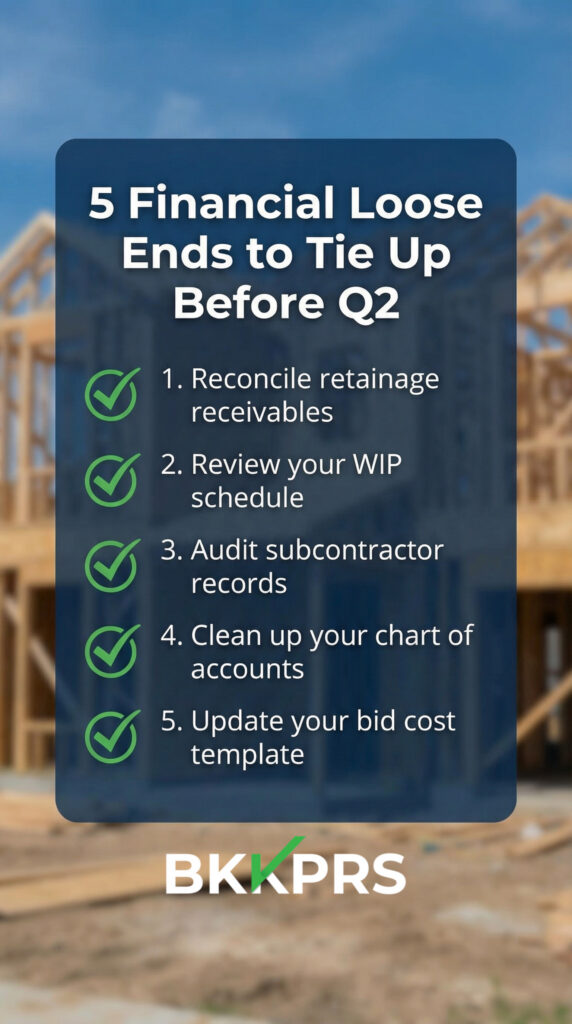
Construction books get messy in a way that most industries never experience. Between retainage, progress billing, change orders, and subcontractor management, there are dozens of places where money can slip through the cracks. A contractor spring cleanup before Q2 ramps up can save thousands in missed revenue and audit headaches.
1. Reconcile Retainage Receivables
Retainage is one of the most commonly mismanaged line items on a contractor’s balance sheet. Jobs close out, final inspections pass, but the retainage never gets billed or collected. Pull every open retainage receivable and confirm that the amount matches the contract terms, that the release conditions have been met, and that an invoice has been sent.
2. Review Your WIP Schedule
Your Work-in-Progress schedule is the single most important financial report in construction. It tells you whether you are overbilled or underbilled on every active job. If you have not updated it since year-end, your financial statements are misleading. Overbilling means you have spent cash you have not yet earned. Underbilling means you have done work you have not been paid for. Both create cash flow problems if left unaddressed.
3. Audit Subcontractor Records
This is the kind of cleanup that feels tedious until it saves you from a compliance headache. Verify that W-9s are current for every active sub. Confirm that certificates of insurance are up to date and have not lapsed. And if you have not yet filed all required 1099s for last year, get that done now before penalties accumulate.
4. Clean Up Your Chart of Accounts
A construction chart of accounts should mirror how you actually run jobs. If your biggest expense category is “Other” or “Miscellaneous,” your P&L is not telling you anything useful. Set up accounts that track labor, materials, subcontractor costs, equipment, and overhead separately by job type.
5. Update Your Bid Cost Templates
Material costs are projected to inflate 2 to 4% this year, with steel and aluminum still elevated from tariff impacts. Labor costs are applying even more pressure. If your bid templates still use last year’s numbers, you are underbidding — and that means you are losing money on every job you win.
| ✅ DIY TAKEAWAY: Contractor WIP Quick Check For each active job, answer these three questions: 1. What percentage of the work is complete? 2. What percentage of the contract has been billed? 3. What percentage of estimated costs have been incurred? If the answers to 1, 2, and 3 are not roughly aligned, you have a WIP problem that needs attention. A job that is 60% complete but only 40% billed means you have done $20K+ of work you have not invoiced on a typical residential project. |
The Bottom Line
Construction is a cash-flow-intensive business, and financial loose ends compound fast. A contractor spring cleanup is not glamorous work, but it is the kind of work that separates contractors who survive uncertain markets from those who do not.
BKKPRS builds financial systems for residential and light commercial contractors. If your books need more than a once-a-year tax prep visit, visit bkkprs.com.
Source: Construction Dive — 5 Construction Trends to Watch in 2026