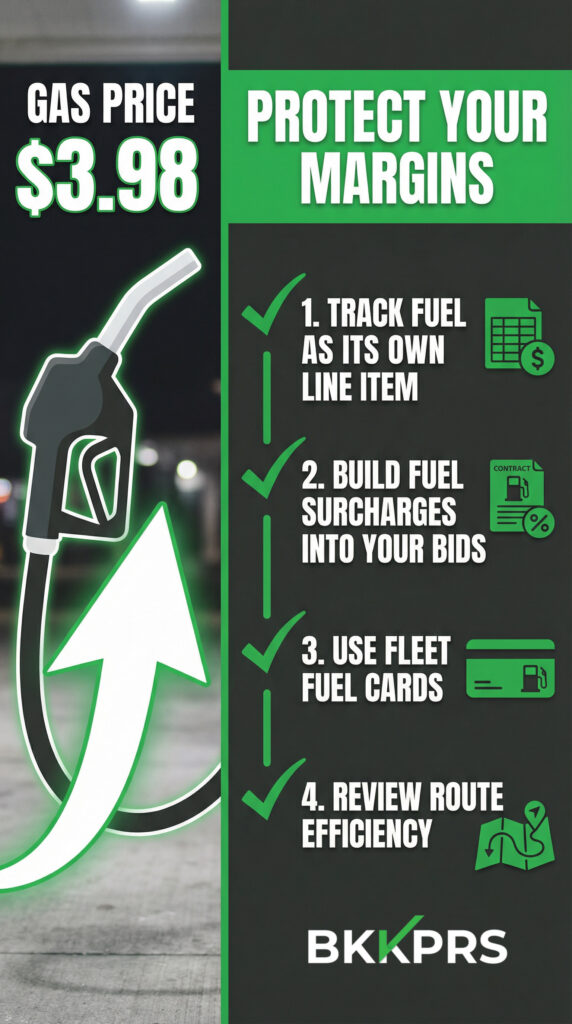
The national average for a gallon of regular gasoline surged to $3.98 in late March 2026 — a jump of roughly a dollar in a single month, driven by the ongoing Middle East conflict and crude oil prices topping $94 a barrel. If your business runs trucks, service vans, or heavy equipment, fuel cost management just moved from a back-burner topic to an urgent priority. And it’s not just gas. Diesel remains stubbornly elevated at nearly $0.80 per gallon above regular gasoline, hitting construction crews, ag operations, and fleet-heavy trades especially hard.
Why This Fuel Cost Spike Feels Different
Earlier in 2026, fuel prices were actually trending down. The EIA’s February outlook projected a full-year average below $3.00 per gallon for the first time since 2020. Then the Strait of Hormuz disruptions changed the math overnight. Brent crude shot from the low $60s to $94 in a matter of weeks, and that increase cascaded through every link in the supply chain.
For small businesses in the trades, construction, and agriculture, this isn’t just a line item that ticks up. Fuel touches material deliveries, equipment operation, technician dispatch, and job-site logistics. When diesel climbs, your concrete delivery costs more, your dozer burns a pricier tank, and every service call eats deeper into margin.
The Hidden Cost: Margin Erosion You Don’t See Coming
The biggest risk with fuel cost spikes isn’t the pump price itself — it’s margin erosion that accumulates invisibly. Most small business owners don’t track fuel as a standalone cost center. It gets buried in “vehicle expense” or “field operations” and doesn’t get a second look until the quarterly P&L comes back thinner than expected.
Here’s a quick example: An HVAC company running 10 service vans averaging 250 miles per week at 15 MPG. At $3.00/gallon, that’s about $1,667/month in fuel. At $4.00/gallon, it’s $2,222 — an extra $555/month or $6,660/year that came out of nowhere. Multiply that for a construction crew running diesel trucks and heavy equipment, and you’re looking at five figures of unplanned cost.
Practical Fuel Cost Management Strategies
You can’t control geopolitics or crude oil prices. But you can control how your business responds. Here are concrete moves that work across trades, construction, and ag operations:
Isolate fuel in your chart of accounts. Create a dedicated fuel expense line — separated from vehicle maintenance, insurance, and other fleet costs. You need to see the number in isolation to manage it. If you’re on QuickBooks Online, this takes five minutes.
Add fuel surcharges or escalation clauses to contracts. Construction contractors and service businesses can reference the EIA’s weekly diesel index as a transparent benchmark. When fuel exceeds a defined threshold, the surcharge activates. Your customers understand this — especially if you explain it upfront.
Implement fleet fuel cards. Fleet cards from providers like Shell or WEX give you per-gallon rebates, purchase controls per driver, and automated expense reporting. No more chasing receipts. More importantly, you get visibility into who’s fueling what, where, and how much.
Optimize route efficiency and dispatch. Tighter job scheduling, geographic clustering of service calls, and GPS-based routing reduce windshield time. Fewer miles driven means fewer gallons burned. Tools like ServiceTitan, Housecall Pro, or even Google Maps route optimization can make a measurable difference.
Build fuel cost into job costing. Every bid and every job should carry a fuel cost allocation based on estimated miles and current pump prices — not last quarter’s prices. This is especially critical for construction contractors pricing multi-week or multi-month projects.
| ✅ DIY TAKEAWAY: Fuel Cost Quick Audit Pull this together in 30 minutes with your bank statements or accounting software: 1. Pull your total fuel spend for the last 3 months. 2. Divide by the number of vehicles/units in your fleet. 3. Calculate cost per mile (total fuel ÷ total estimated miles driven). 4. Compare your per-mile cost to 3 months ago and 12 months ago. 5. Multiply the per-mile increase by your projected annual miles to estimate your annual impact. That single number — your annual fuel cost increase — is what you need to decide whether to adjust pricing, add surcharges, or restructure routes. |
The Bottom Line
Fuel prices are volatile, and the current geopolitical environment suggests they’ll stay that way for a while. The businesses that come out ahead aren’t the ones hoping for prices to drop — they’re the ones building fuel cost management into their financial systems now. Isolate the cost, track it weekly, build it into your bids, and protect your margins with surcharges and smarter operations.
At BKKPRS, we help trades, contractors, and ag operators build the financial reporting and job costing infrastructure that catches margin leaks like this before they drain your bottom line. No lock-in contracts, no fluff — just clear numbers and the consulting to act on them.
Let’s talk. → bkkprs.com
SOURCES
- U.S. Energy Information Administration — Gasoline and Diesel Fuel Update
- EIA Short-Term Energy Outlook, March 2026 — eia.gov/outlooks/steo
- Baldwin CPAs — Construction Costs: How PPIs Guide Smarter 2026 Bids