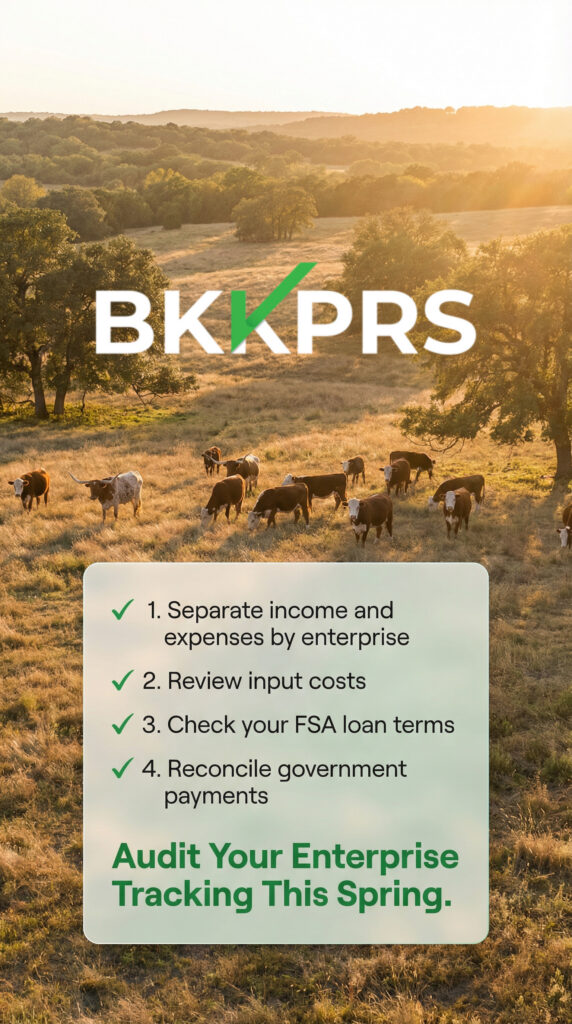
If you run a diversified ranch operation — cattle, hay, hunting leases, maybe crops or agritourism — do you know which enterprise is actually making money? For most ranch operators, the honest answer is no. That is where ranch enterprise tracking comes in, and spring is the best time to set it up or fix it.
Why Enterprise Tracking Matters More in 2026
USDA is forecasting net farm income to decline about 2.6% in inflation-adjusted dollars this year. Overall farm cash receipts are expected to drop $14.2 billion. At the same time, production expenses are rising — fertilizer is up 10 to 15% depending on your region, and labor costs continue to climb.
When margins tighten, you cannot afford to subsidize a losing enterprise with a profitable one without knowing it. Enterprise tracking gives you the visibility to make those calls.
How to Audit Your Ranch Enterprise Tracking
Start by listing every income stream on your operation. Common enterprises include cow-calf, stocker cattle, hay production, row crops, hunting or recreational leases, and direct sales. Each one should have its own income and expense categories in your accounting system.
Next, review how expenses are allocated. Feed, fuel, labor, and equipment costs often get dumped into a single bucket. But the hay enterprise has very different input costs than the cattle enterprise, and combining them hides the true profitability of each.
Check your government payment tracking as well. The OBBBA significantly increased ARC and PLC payments for 2026 crop year, with Farm Bill payments forecast at $15.2 billion. Conservation payments from FSA and NRCS programs are also up 4.3%. These payments should be allocated to the appropriate enterprise, not just treated as general income.
Ranch Enterprise Tracking and USDA Programs
USDA’s Farm Service Agency published March 2026 lending rates, and FSA loans remain an important capital access tool for producers. But lenders want to see clean, enterprise-level financials when evaluating loan applications. If your books treat the entire operation as one lump, you are making it harder to secure financing and harder to demonstrate the viability of the enterprise you are borrowing for.
| ✅ DIY TAKEAWAY: Enterprise Profitability Snapshot Create a simple spreadsheet with one row per enterprise and these columns: 1. Enterprise name (e.g., Cow-Calf, Hay, Hunting Leases) 2. Total income for the last 12 months 3. Total direct expenses (feed, seed, fertilizer, labor, etc.) 4. Gross margin (income minus direct expenses) 5. Percentage of total operation revenue If any enterprise shows a negative gross margin, it deserves immediate attention. If you cannot fill in the numbers, your tracking system needs work. |
The Bottom Line
Tight margins demand precision. Ranch enterprise tracking is not about making bookkeeping more complicated — it is about giving you the data to protect your operation when the market is not doing you any favors.
BKKPRS understands ag operations firsthand — we raise miniature cattle in Boerne, TX. If your books need to be restructured to track each enterprise properly, visit bkkprs.com.
Source: USDA ERS — Farm Sector Income Forecast