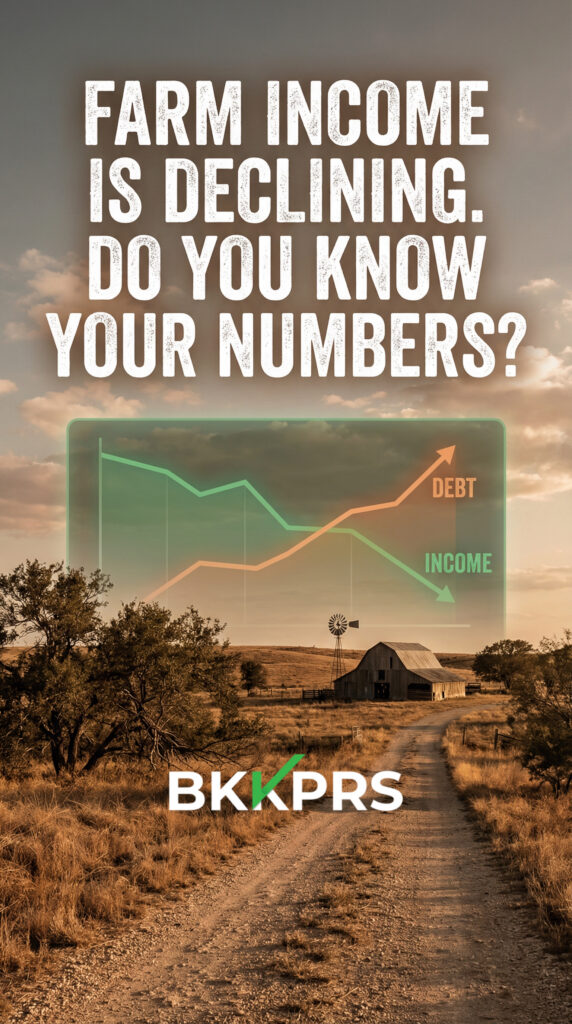
USDA’s latest forecast makes the trend clear: net farm income is declining. The 2026 forecast shows a $4.1 billion drop in inflation-adjusted terms, with overall cash receipts expected to fall $14.2 billion. At the same time, production expenses are rising, total farm debt is forecast to increase 5.2%, and solvency measures are weakening.
These are not alarmist projections — they are the official numbers from USDA’s Economic Research Service. And for farm and ranch operators in Texas, understanding what they mean is the first step toward protecting your operation.
What Is Driving Farm Income Declining Trends
Crop receipts are under pressure from softer export demand and competition from South American producers. Livestock receipts are mixed, with cattle operations as one of the few bright spots. Input costs continue to climb — fertilizer is up 10 to 15%, labor expenses are projected at $53.9 billion (up 2.2%), and livestock purchases are forecast to increase nearly 10%.
The one significant bright spot is government support. The OBBBA dramatically increased ARC and PLC payments for the 2026 crop year, with Farm Bill commodity payments forecast at $15.2 billion — a $13.1 billion increase from 2025. Conservation payments are also up 4.3%.
How to Protect Your Operation
The operators who navigate declining income best are the ones with clear visibility into their financial position. That starts with enterprise-level tracking so you know exactly which parts of your operation are profitable and which are not.
Build cash flow projections based on current input costs, not last year’s. If fertilizer is up 15% and you are still using old numbers in your budget, your projections are wrong and your breakeven calculations are too low.
Take advantage of available programs. FSA loan rates for March 2026 are published. ARC and PLC enrollment decisions should be based on current commodity price projections, not habit. Conservation programs through NRCS can provide both financial assistance and long-term land improvement.
Working Capital and Solvency
USDA forecasts that farm sector working capital will decline in 2026 and solvency will continue to weaken as debt grows faster than assets. For operators carrying significant debt, this means monitoring your debt-to-asset ratio monthly and having honest conversations with your lender before problems become crises.
| ✅ DIY TAKEAWAY: Farm Financial Health Scorecard Answer these five questions for your operation: 1. Do you know your breakeven price per unit for each major commodity or product? (Y/N) 2. Have you updated your operating budget with 2026 input costs? (Y/N) 3. Do you track income and expenses by enterprise? (Y/N) 4. Have you reviewed your ARC/PLC enrollment for the current crop year? (Y/N) 5. Do you know your current debt-to-asset ratio? (Y/N) If you answered No to three or more of these, your financial reporting needs immediate attention. |
The Bottom Line
Farm income declining is the reality for 2026. But declining income does not have to mean declining operations. The producers who survive downturns are the ones with clear financial visibility, disciplined cost management, and advisors who understand agriculture.
BKKPRS works with farm and ranch operations across Texas. We understand the business because we live it. Visit bkkprs.com to learn how we can help protect your operation.
Source: American Farm Bureau Federation — USDA Cuts 2025 Farm Income