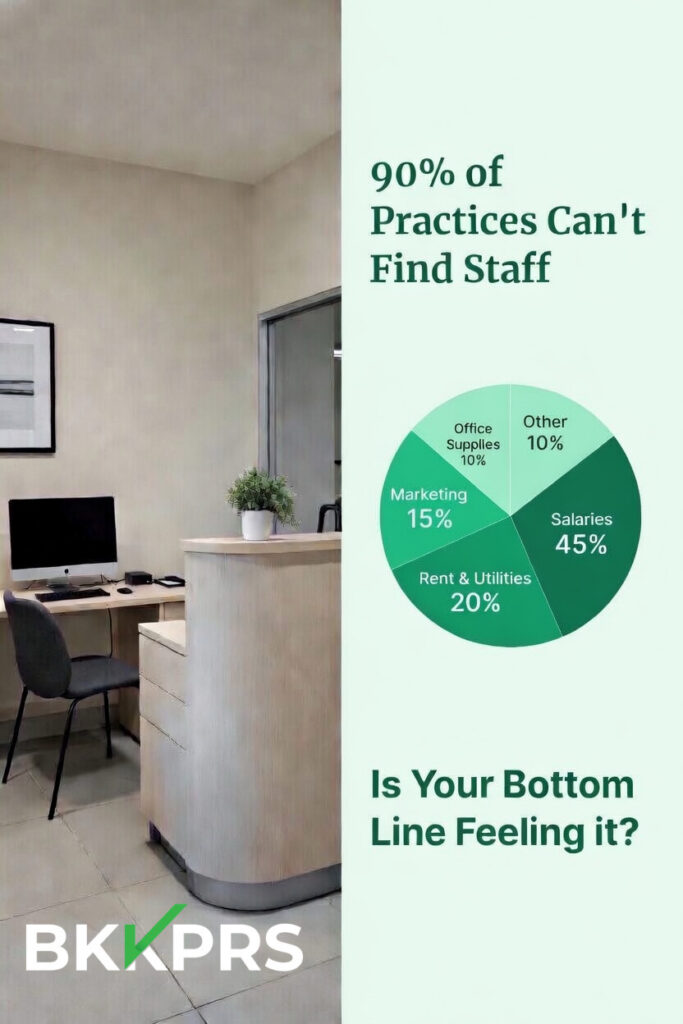
The ADA’s Health Policy Institute confirmed it again: about 90% of dental practices report ongoing difficulty hiring staff heading into 2026. The dental staffing shortage is not a temporary blip. It is a structural reality that is reshaping practice economics.
The Dental Staffing Shortage Is a Financial Problem
When you cannot fill a hygiene chair, you lose production. When you rely on temporary staff at premium rates, your overhead climbs. When your team is burned out from carrying extra load, turnover increases — and replacing an employee costs 50 to 200% of their annual salary when you factor in recruiting, training, and lost productivity.
This is not just an HR challenge. It is a financial management challenge, and it needs to be addressed with financial tools.
Managing the Financial Impact
Start tracking production per provider. Know exactly what each hygienist and associate generates per hour and per day. This data tells you whether a staffing gap is costing you $5,000 a month or $15,000 a month — and whether the cost of a premium temp hire is justified by the production they generate.
Monitor overhead by category, not just in total. Staff costs, supplies, lab fees, and facility expenses each behave differently during a staffing shortage. Your supply costs should stay flat, but your per-unit labor cost probably increased. If everything is going up at once, you have a broader problem than staffing.
Build financial models around different staffing scenarios. What does your P&L look like with a full team? With one hygienist short? With two? These models help you make informed decisions about when to invest in recruiting versus when to optimize with your current team.
Technology and Efficiency as a Financial Strategy
Practices that are investing in AI-enabled diagnostics and digital workflows are not doing it because the technology is trendy. They are doing it because it allows existing staff to be more productive. Faster radiographic analysis, streamlined scheduling, automated patient reminders — these tools do not replace staff, but they maximize the output of the staff you have.
| ✅ DIY TAKEAWAY: Staffing Cost Impact Calculator Calculate the financial impact of your current staffing gaps: 1. Identify any unfilled positions (hygienist, assistant, front desk) 2. Estimate the production loss per day for each unfilled clinical position (use your production per provider data) 3. Multiply by the number of working days the position has been vacant 4. Add temp agency costs, overtime, and any sign-on bonuses paid 5. Total = your staffing shortage cost This number is what you are actually losing. Compare it to the cost of a competitive compensation package for a permanent hire. |
The Bottom Line
The dental staffing shortage is not going away in 2026. The practices that thrive will be the ones that manage it as a financial challenge, not just an operational one. Track production, monitor overhead, model scenarios, and invest in efficiency where it delivers measurable returns.
BKKPRS helps medical and dental practices build the financial reporting and analysis they need to navigate staffing challenges with clarity. Visit bkkprs.com.
Source: ADA Health Policy Institute — Dental Industry Predictions for 2026