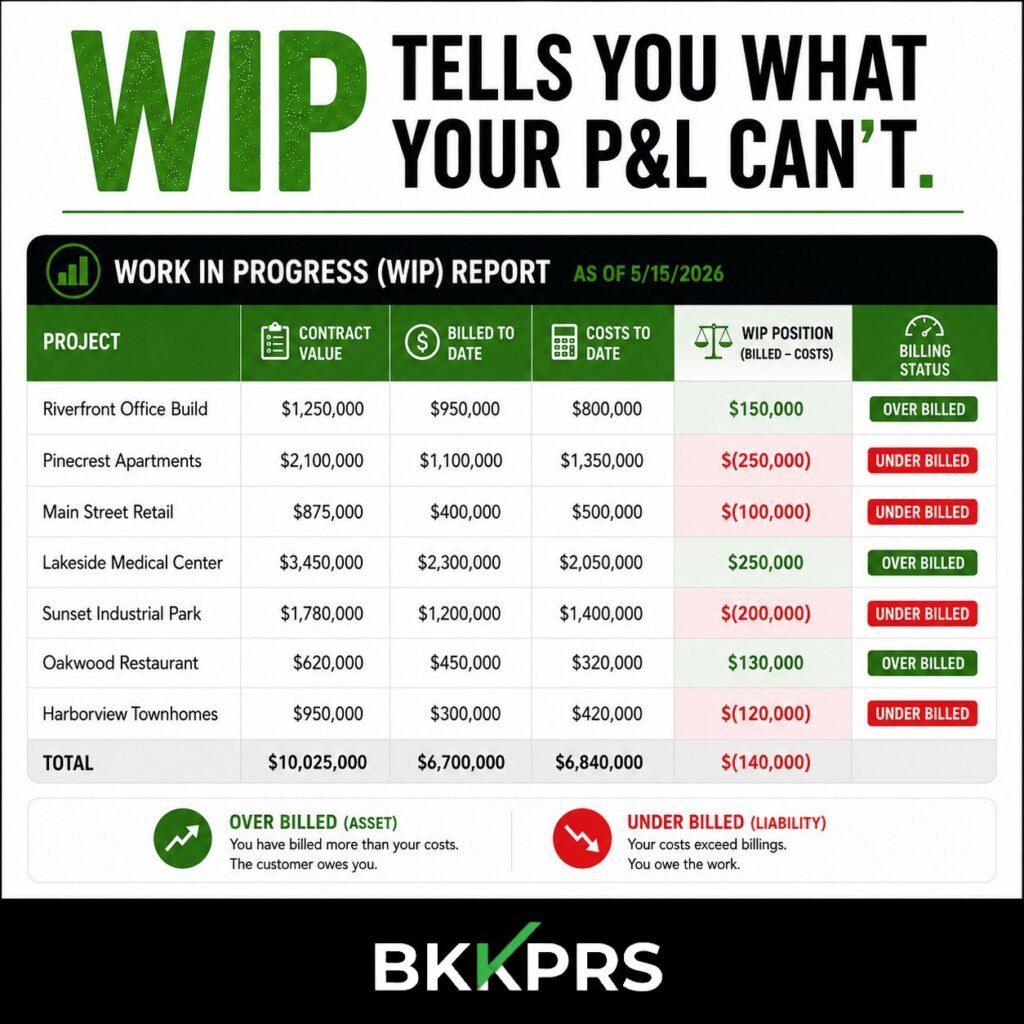
If you’re a residential or light commercial builder and you can’t pull a Work-in-Progress (WIP) report that shows the status of every active project, you’re managing your business with one eye closed. Your P&L tells you what happened last month at the company level. Your WIP report tells you what’s actually happening across every active project — right now, in detail, project by project. That’s a fundamentally different and more useful view.
What WIP Reporting Actually Shows
A proper WIP report shows, for each active project, the relationship between three numbers: how much work has been performed, how much has been billed, and the difference between them. That gap — the over-billing or under-billing position — is where the most important information lives.
The columns of a standard WIP report look like this: original contract value, approved change orders, total revised contract, cost incurred to date, estimated cost to complete, percent complete (cost incurred divided by total estimated cost), revenue earned to date (percent complete multiplied by revised contract), amount billed to date, and over/under billing position (revenue earned minus amount billed).
If your bookkeeping isn’t structured to produce those numbers, your books aren’t built for construction.
The Over-Billing Trap
Most contractors love front-loaded billing schedules — get the cash in early, fund material purchases, pay subs, keep the project moving. That’s fine, and it’s how most construction work has always been financed. But when billing runs ahead of actual progress, your WIP report shows you in an over-billed position.
Over-billing isn’t inherently bad. It’s a cash flow tool. But it becomes dangerous when contractors confuse cash collected with revenue earned. You’ve billed $200,000 on a project that’s only 30% complete? That’s $140,000 of revenue you haven’t actually earned yet — and you’ve got $140,000 worth of costs coming that have already been paid for in cash.
If you don’t see that over-billing position clearly, you spend the money. The project finishes. The final costs land. And suddenly your ‘profitable’ project shows up as a loss.
The Under-Billing Trap
The opposite problem is just as costly, and more common in residential remodeling. You’ve completed 60% of a project — significant labor and materials are already invested — but you’ve only billed 40%. That’s earned revenue you haven’t invoiced. It’s working capital sitting in the form of partially-completed work, costing you cash every day until you collect.
Under-billing typically happens when contractors are uncomfortable asking for draws, when billing milestones don’t align with actual progress, or when scope creep delays formal invoicing. The fix isn’t a bigger contract — it’s a tighter billing process tied to actual work performed.
How Often to Run WIP
WIP reporting should be a monthly minimum. Quarterly is too slow for most residential and light commercial contractors. Weekly is ideal for builders with significant active project volume.
| ✅ DIY: WIP REPORTING WORKFLOW 1. Track costs at the project level — every labor hour, every material purchase, every sub payment must be coded to a project 2. Update estimated cost to complete monthly — this is the most important number on the report and the one most contractors get wrong 3. Calculate percent complete as (cost incurred ÷ total estimated cost), not as a subjective ‘how far along do we feel’ estimate 4. Review WIP before every progress draw — make sure you’re billing in line with earned revenue 5. Flag any project where over-billing exceeds 20% of total contract value 6. Flag any project where under-billing exceeds $10,000 7. Use the WIP report as the foundation for cash flow forecasting 60-90 days out |
Why This Matters for Bonding and Lending
If you ever need bonding for larger commercial work — performance bonds, payment bonds, license bonds — the bonding company will ask to see your WIP report. So will any serious lender. So will any buyer evaluating your business for acquisition. Clean WIP reporting isn’t a nice-to-have; it’s a signal of operational maturity that opens doors you didn’t know were closed.
The Bottom Line
Your P&L tells you what happened. Your WIP report tells you what’s about to happen. Residential and light commercial builders who run monthly WIP have the visibility to spot trouble before it hits, bill in line with actual progress, and forecast cash flow with real accuracy.
BKKPRS builds construction-specific bookkeeping for residential builders, remodelers, and light commercial contractors — including WIP reporting, job costing, and the financial reporting that supports bonding and lending. Visit bkkprs.com.
📎 Source: APB — 41 Construction Industry Trends (2026)