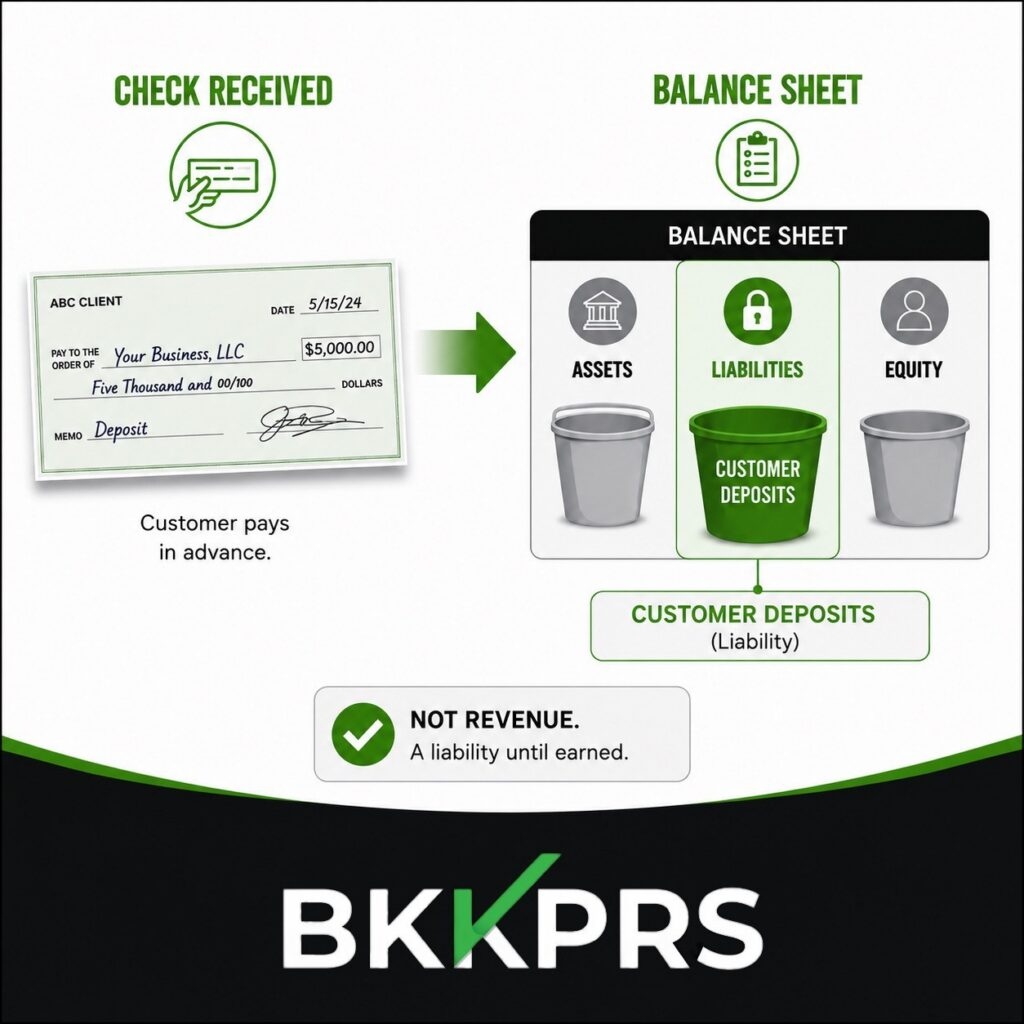
Commercial electrical work runs on a different financial rhythm than residential service. Bids get accepted weeks or months before work actually starts. Customers want to lock in crews. And increasingly, those customers are willing to put down meaningful deposits to reserve your capacity — sometimes 10% or more of the project value, paid weeks or months before the first wire gets pulled.
That’s good news for your cash flow. It’s also one of the most commonly mishandled situations in electrical contractor bookkeeping. When capacity reservation deposits hit your bank account, how they’re recorded matters as much as the fact that you received them.
The Core Issue: Deposits Are Not Revenue
Here’s the temptation: a $25,000 deposit lands in your operating account. The cash is real, the customer has signed a contract, and the work is scheduled. So you book it as revenue. Easy.
That’s wrong, and it creates three problems.
First, your monthly P&L gets distorted. The deposit shows up as income in May, even though the work won’t happen until August. Your May numbers look strong and your August numbers look weak — and neither reflects what your business actually earned.
Second, you create unnecessary tax exposure. Cash-basis taxpayers often confuse ‘I received the cash’ with ‘I have earned the income.’ For most service contracts, the IRS recognizes that you don’t truly earn the income until the work is performed. Booking it as revenue prematurely can accelerate your tax bill on income you haven’t actually earned.
Third, if the project falls through and you owe the deposit back, you’re going to have to reverse out revenue you’ve already recognized — and explain that reversal to your CPA, your lender, or anyone else looking at your financials.
The Right Way to Book Capacity Reservation Deposits
Deposits should be recorded as a liability — money you owe the customer (in the form of future work) — not as revenue. Most accounting systems allow you to set up a ‘Customer Deposits’ liability account specifically for this purpose.
When the deposit comes in, it increases cash and increases the Customer Deposits liability. As work is performed, you progressively move portions of the deposit from the liability account into earned revenue. By the time the project is complete, the liability is zero and the revenue has been recognized in the months it was actually earned.
How This Works in Practice
| ✅ DIY: CAPACITY DEPOSIT ACCOUNTING WORKFLOW 1. Create a ‘Customer Deposits’ liability account in your chart of accounts 2. When a deposit is received, record: DEBIT Cash / CREDIT Customer Deposits 3. Track each deposit separately by project and customer 4. As work is performed, recognize earned revenue based on percentage of completion or milestone billing 5. The journal entry: DEBIT Customer Deposits / CREDIT Revenue 6. Review the Customer Deposits balance monthly — every dollar should be traceable to an active project 7. Refund any unused deposits properly if a project is cancelled |
Texas Sales Tax Considerations
In Texas, the timing of when sales tax applies to deposits depends on whether the work is taxable. Electrical contracting services are generally non-taxable when they qualify as new construction or capital improvements, but other services may be subject to sales tax. Proper deposit categorization helps your CPA make the right call on when (and whether) tax obligations attach to your deposits.
The Bottom Line
Capacity reservation deposits are a powerful cash flow tool for commercial electrical contractors. They give you working capital, lock in customer commitment, and let you plan crews and material orders with more confidence. Just make sure your books reflect them as what they are — customer money held for future work, not revenue earned today.
BKKPRS builds bookkeeping systems for electrical contractors that handle commercial deposits the right way. Visit bkkprs.com.
📎 Source: Fortune Business Insights — MEP Services Market 2026