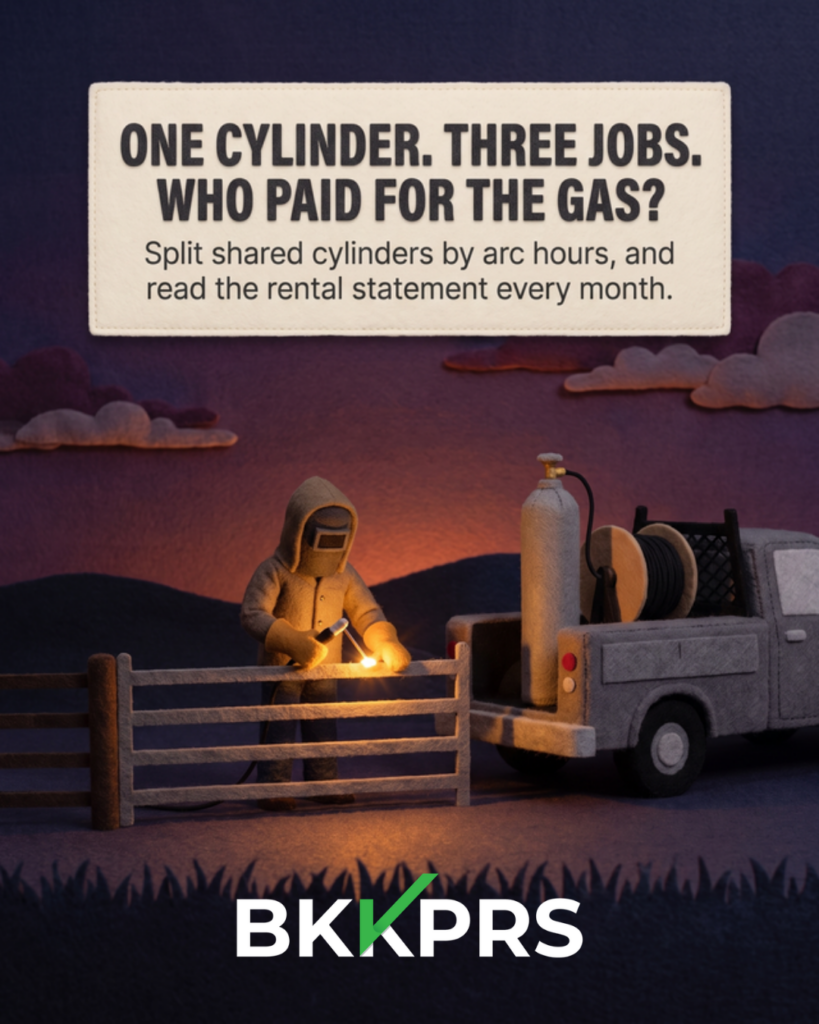
Fall keeps welders across the Texas Hill Country busy. Ranch gates and cattle guards need fixing before winter. Stock trailers and feeders get patched before hunting season. Shops in Boerne and Kerrville are turning out stair rails and equipment repairs.
Every one of those jobs burns consumables. Shielding gas, MIG wire, stick electrodes, TIG filler rod, tungsten, contact tips, nozzles, grinding discs, and cutoff wheels. Each purchase is small. Over a busy month, they add up to real money. And in a lot of small welding shop books, they all land in one place: shop supplies, right next to the shop towels and the hand soap.
That one coding choice is enough to make job reports look better than they are. This post walks through why welding consumables job cost tracking matters, how to set up the accounts, how to split a shared cylinder by arc hours, why the cylinder rental statement deserves a monthly look, and what to do this week.
Why welding consumables are a job cost
A cost belongs to a job when the job caused it. The gas only flows when the arc is lit on that gate. The wire only feeds into that trailer tongue. Beancount, in a September 2026 guide for mobile welders and fabricators, puts it plainly: stop lumping shielding gas, MIG wire, stick electrodes, TIG filler rod, and tungsten into shop supplies alongside office paper. Those consumables are used up by specific jobs, which makes them direct costs of the work.
AD Bookkeepers, in a CPA reviewed guide to welding and fabrication bookkeeping published the same month, makes the same point from the other direction. Gas, wire, rods, grinding discs, cutting tips, and abrasives are small individually and significant in total. Where they can be tied to jobs, code them to the job. Where they cannot, build them into the shop rate so every hour you bill recovers them.
Either way, the work that used the consumables should pay for them.
Where consumables go missing
Consumables rarely disappear on purpose. They slip through a few familiar cracks:
- The gas supplier invoice gets paid by check or card and coded to shop supplies, with no job named.
- One run to the welding supply house covers wire for three jobs and discs for the shop, all on one receipt, all in one account.
- Contact tips, nozzles, and liners get bought by the box and never tied to anything.
- Grinding discs and cutoff wheels get grabbed off the shelf and never logged.
- Cylinder rental shows up on a monthly statement that nobody reads closely.
None of these is a disaster on its own. Together they mean the job report shows labor and steel, and not much else.
An illustrative example
Here is a hypothetical example with round numbers. It is for teaching only. It is not a price list, a shop rate recommendation, or a benchmark for your area.
Picture a mobile welder working out of Kerrville who finishes a ranch gate and fence panel repair for $2,400. The job report shows $900 of labor and $500 of steel and hardware. That looks like $1,000 of margin, about 42 percent.
Now put the consumables back on. Say the job burned through most of a gas cylinder fill, part of a wire spool, a handful of tips, and a stack of grinding and cutoff discs, together about $220 in this example. The margin drops to $780, or about 33 percent. Same gate. Same invoice. Roughly nine points of margin the books were hiding.
The real problem shows up on the next quote. If you price the next gate off the job report that said 42 percent, you build the same gap into the next job, and the one after that. Across a busy fall, those gaps become the difference between a good season and a season that felt busy but never showed up in the bank account.
How to set up the books
You do not need special software. You need a few accounts, one tagging habit, and one split rule.
The accounts: Beancount suggests at least three consumable accounts. One for shielding gas. One for wire and electrodes, including filler rod and tungsten. One for abrasives and cutting consumables, like grinding discs, flap wheels, cutoff wheels, and plasma tips. Put them inside job costs, not general overhead. Keep true shop items like safety glasses, shop towels, and discs used for shop maintenance in supplies, on purpose.
The habit: code every gas and welding supply receipt to the job it served, at the time you enter it. If one supply run covers three jobs, split the receipt across those jobs.
The split rule: cylinders are the tricky one, because one fill can stretch across several jobs. Beancount’s suggestion is to split by arc hours, or by your best reasonable estimate. A simple approach is to note the date a cylinder goes on the rig and the jobs it covers until it runs empty, then divide the fill cost across those jobs by hours on site. Approximate allocation beats no allocation.
Whatever you truly cannot tie to a job still has to be recovered. AD Bookkeepers recommends building those consumables into your shop rate. That way the cost is covered on every hour, even when it never shows up on a single job line.
Do not forget the cylinder statement
Cylinder rental is easy to overlook because it arrives as a quiet monthly charge. AD Bookkeepers points out that cylinders that never got returned keep costing money. Once a month, compare the supplier statement to the cylinders actually on your rig and in the shop. Send back what you are not using, and question any cylinder you do not recognize.
A consumables checklist
Before the next supply run, make sure each of these is true:
- Shielding gas, wire and electrodes, and abrasives and cutting each have their own account inside job costs.
- Every gas and welding supply receipt carries a job name when it is entered.
- Supply runs that cover several jobs get split across those jobs.
- Shared cylinders get split by arc hours or a reasonable estimate.
- Consumables you cannot tie to a job are built into the shop rate.
- The cylinder rental statement gets checked against what is on hand every month.
- Shop supplies holds real shop items only.
What to do this week
Pull every gas supplier and welding supply receipt from September. Recode what you can to the jobs it served, and move true shop items back to supplies. Then look at your three biggest jobs from last month and see how the margin changes with consumables on the job. If the gap is bigger than you expected, that is useful information before you quote the next round of fall work. Finally, count the cylinders actually on the rig against the latest rental statement.
Before the next cylinder swap
The arc does not care which account you code it to. Your next quote does. Put the consumables on the job.
Sources
Beancount.io: Mobile Welding Bookkeeping: Trigger Time, Consumables as Job Costs, and How to Price an Arc Hour (Sept 13, 2026; consumables as direct job costs, three consumable accounts, cylinder split by arc hours): https://beancount.io/blog/2026/09/13/mobile-welding-fabricator-bookkeeping-trigger-time-cogs-pricing-guide
AD Bookkeepers: Welding and fabrication bookkeeping: shop rate and steel (Sept 22, 2026; consumables add up, code to jobs or recover in shop rate, check cylinder rental monthly): https://adbookkeepers.com/resources/welding-and-fabrication-bookkeeping