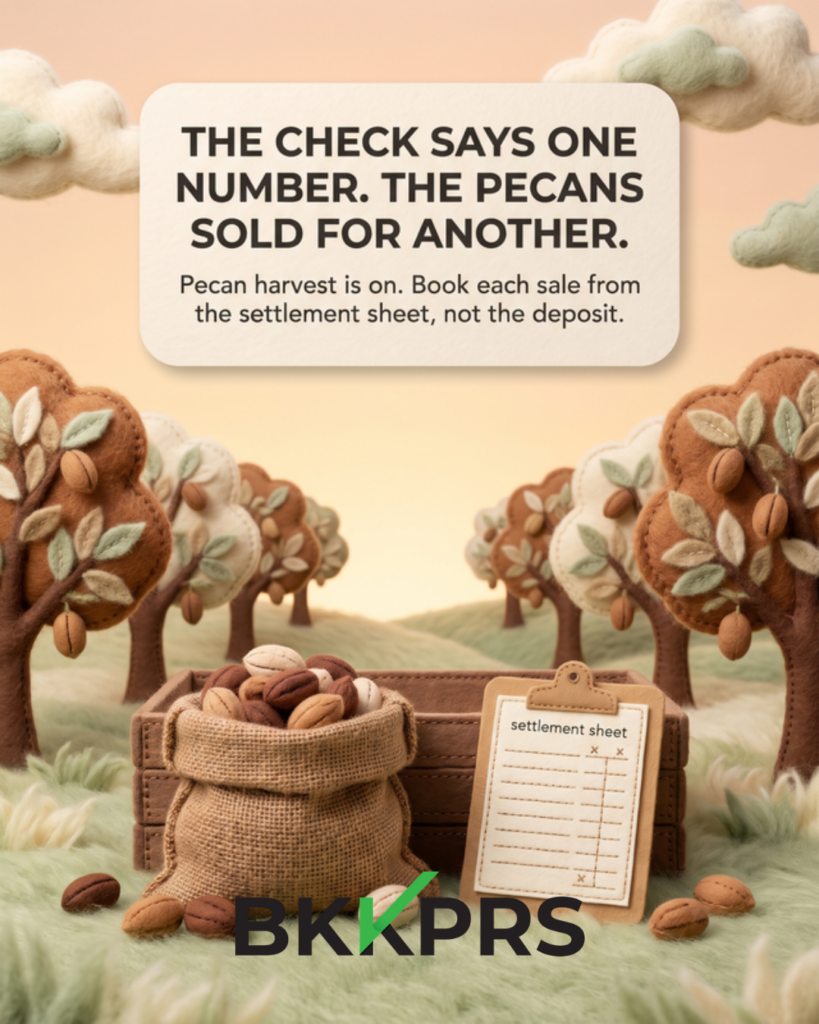
Pecan harvest season is rolling across the Hill Country, from the orchards around San Saba to the native trees along the creeks near Fredericksburg and Llano. Shakers and harvesters come out, the first loads go to buyers and accumulators, and the first checks start showing up.
This year’s crop still looks bigger than last year’s. In its October crop production report, USDA’s National Agricultural Statistics Service forecast Texas pecan production at 44.5 million pounds, up from 41.6 million pounds in 2025, with 39 million pounds of improved varieties and 5.5 million pounds of natives. Quality is the open question. In a September AgriLife Today report, Texas A&M AgriLife pecan specialist Monte Nesbitt warned that a hot, extremely dry spell arrived right at kernel fill and that shriveled, malformed kernels can hide inside normal looking shells.
That makes the grade on every lot matter, and it makes the paperwork behind every check matter more than usual.
How a pecan check gets built
Pecans are not usually sold at one flat price per pound. New Mexico State University’s extension guide to pecan prices and grades explains that buyers sample each lot, run a shell out test, and grade on nut size, meat size, kernel color, and shell out percentage. The grower’s in shell price is then the price per pound of nutmeat times the kernel percentage. In NMSU’s example, a Fancy lot that shells out at 58 percent, at $3.90 per nutmeat pound, pays $2.26 per pound in shell.
The Texas Pecan Growers Association’s marketing guide for small growers lists the factors behind that price: nut size, variety, percentage marketable kernel, kernel quality and color, moisture, lot volume, location, and the time of season. It recommends pulling a representative sample from each lot to size, shell, and grade before you market, so the price reflects the actual value of your nuts. Texas A&M’s guide to commercial pecan orchards in Texas adds that large volumes can go straight to shellers while many growers sell to local accumulators.
Then come the deductions. Under the Texas Pecan Board’s rules, the first handler who buys your pecans collects the board’s half cent per pound assessment by deducting it from the purchase price, and the assessment is recorded on the invoice and sales receipt given to the producer. The rules include an exemption for some smaller producers, so not every receipt will show it. If the same outfit cleaned or hauled for you, those charges may be netted on the same settlement too. The sheet will say.
Why the deposit is the wrong record
When the check gets deposited and coded as pecan income, the books record a number that was never a price. It is not the sale. It is not the cost. It is the difference between them. That causes three problems.
Your price per pound disappears, so you cannot compare buyers, lots, or seasons.
Assessments and fees vanish into the sale, so your cost of selling looks smaller than it is.
Pounds and kernel percentages never make it into the records, so you cannot tell which block or variety earned the most.
Book it in three pieces
Treat every settlement sheet like an invoice in reverse.
Record the gross sale to a pecan sales income account. Put pounds, percent kernel, grade, and price in the memo.
Record each deduction to its own expense line: assessment, cleaning, hauling, or whatever else the sheet shows.
Record the net as the deposit, and confirm it matches the check to the penny.
Most bookkeeping software handles this as a single deposit with several lines, one positive and the rest negative. Attach a scan or photo of the settlement sheet to that entry. If you also sell pecans at the orchard or a farmers market, give those sales their own income account. AgriLife notes that more growers are turning to direct to consumer sales, and those dollars behave very differently from a buyer check.
Tag the lot
If you run more than one block or variety, or harvest both improved and native trees, tag each sale with a class or location. NASS reports improved and native production separately for a reason: they are different crops in the market. By the end of harvest you will have pounds, kernel percentage, and net price by block, which is exactly what you want in hand when you plan next year’s spray and irrigation budget.
An illustrative example
Here is a hypothetical example with round numbers, for teaching only. It is not a price forecast. Picture a San Saba County grower who delivers 8,000 pounds of improved pecans to a buyer. The sample shells out at 55 percent and the buyer pays $4.00 per nutmeat pound, so the in shell price is $2.20 a pound and the gross sale is $17,600.
The settlement shows two deductions: the state assessment at half a cent a pound, which comes to $40, and a cleaning charge of $480. The check is $17,080.
If the check goes in as income, the books say this lot sold for about $2.14 a pound and cost nothing to sell. Booked in three pieces, the books show $17,600 of sales at $2.20, $520 of selling costs, and a $17,080 deposit that matches the bank. A week later, a load from the native trees along the creek shells out at 46 percent and grades lower. Tagged by block, the two lots sit side by side in the records, and next year’s marketing decisions start with real numbers.
A pecan sales records checklist
Every load has a settlement sheet or receipt on file.
Gross sale, pounds, percent kernel, grade, and price are recorded.
Each deduction has its own expense line.
The net deposit matches the check exactly.
Sales are tagged by block, variety, or improved versus native.
Retail and direct sales have their own income account.
What to do this week
Pull every settlement sheet from this season so far and lay them next to the bank deposits. For any check that went in as one number, split it into the gross sale and deductions, and add pounds and percent kernel to the memo. Set up a class or tag for each block before the next load goes out, so the rest of harvest gets recorded the right way from the start.
Before the next check lands
The check tells you what landed in the bank. The settlement sheet tells you what your pecans were worth. Book the sale, not just the check.
Sources
USDA NASS: Crop Production, October 2026 (released Oct 9, 2026; pecan forecast by state and variety): https://release.nass.usda.gov/reports/crop1026.pdf
Texas A&M AgriLife Today: Pecan production, prices up in Texas as disease, dry weather loom (Sept 1, 2026): https://agrilifetoday.tamu.edu/2026/09/01/pecan-production-prices-up-in-texas-as-disease-dry-weather-loom/
New Mexico State University Extension: Pecan Prices and Grades, Z502 (shell out test; in shell price formula): https://pubs.nmsu.edu/_z/Z502/index.html
Texas Pecan Growers Association: Marketing for the small pecan grower (price factors; sample and grade each lot): https://tpga.org/educations/marketing-for-the-small-pecan-grower/
Texas Pecan Board: Rules (adopted Feb 19, 2019; first handler deducts the half cent per pound assessment; shown on invoice and receipt): https://www.texaspecanboard.com/_files/ugd/d6e03e_42cc9b7547894dcd9cfb8373e8eb8acd.pdf
Texas A&M Aggie Horticulture: Commercial Pecan Orchards in Texas (shellers and local accumulators): https://aggie-horticulture.tamu.edu/fruit-nut/commercial-pecan-orchards-in-texas/