Fall is full on the flooring calendar across the Texas Hill Country. Homeowners in Boerne want new floors down before family shows up for Thanksgiving. Remodelers in Kerrville and Comfort are wrapping kitchens and baths that started in late summer. Builders want finish floors in before year end walkthroughs. A busy flooring shop can install carpet on Monday, luxury vinyl plank on Wednesday, and porcelain tile the rest of the week.
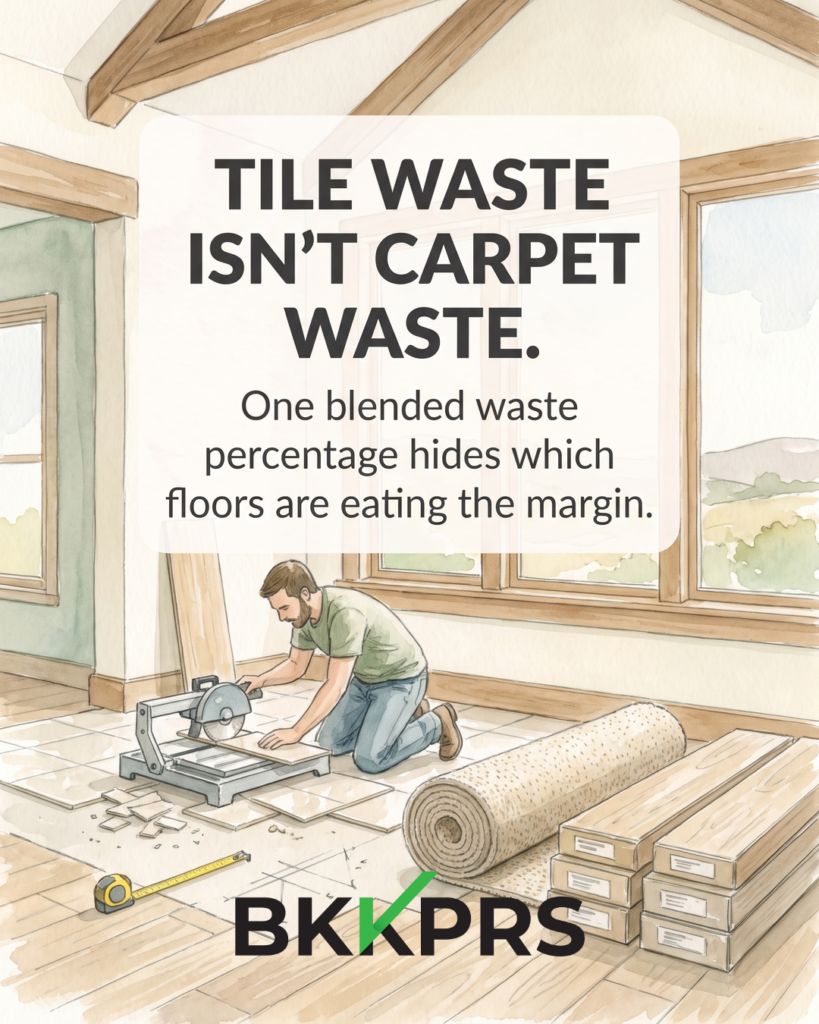
Each of those materials comes off the truck with a different amount of extra built in for cuts, pattern, breakage, and layout. That extra is the waste factor. Plenty of small flooring shops still run one blended waste percentage on every bid and every job report. It is simple. It also hides which floors are quietly eating the margin.
Why one waste percentage fails
Construction Cost Accounting, a bookkeeping firm that works with flooring contractors, puts it plainly: waste factors are material specific. Tile and stone typically lose more to cuts and breakage than carpet or LVP. Its advice is to track an expected waste factor by material type and compare it with actual job waste, so you can tell a normal cut loss from a job that is bleeding material cost.
The same source points out that material type changes the whole economics of a job. Carpet tends to be lower material cost with fast installs and high volume. Tile and stone sit at the other end, with the highest material cost and the slowest, most skilled installs. Hardwood and LVP land in between, with LVP margins varying widely by product. A single blended waste rate averages all of that together, and an average can look fine while one material runs well over.
What the books need to see waste
You cannot compare actual waste to expected waste if the books only know one number called flooring materials. A few pieces make waste visible:
- Material cost tracked by job and by material type, not one blended materials account.
- An expected waste factor set for each material you install, written down where estimating and the office can both see it.
- Square footage ordered and square footage installed recorded on each job.
- Extra material runs and returns recorded against the job that caused them.
Those four pieces let you calculate actual waste on a job in a minute, and roll it up by material at the end of the month.
An illustrative month of waste by material
Here is a hypothetical month with round numbers. The waste percentages and prices are made up for teaching. They are not industry benchmarks or a recommendation for how to bid.
Picture a Boerne flooring shop that uses one 10 percent waste allowance on every job. In October it installs 6,000 square feet of carpet, 4,000 square feet of LVP, and 2,000 square feet of porcelain tile. The shop’s own history says carpet should waste about 5 percent, LVP about 8 percent, and tile about 15 percent. Here is what actually happened:
- Carpet wasted 300 square feet, right at 5 percent.
- LVP wasted 320 square feet, right at 8 percent.
- Tile wasted 440 square feet, or 22 percent, seven points over its own factor.
Add it up and the shop wasted 1,060 square feet on 12,000 installed, about 8.8 percent. Against a blended 10 percent allowance, October looks like a good month. Nobody looks closer.
But tile ran 140 square feet over its own expected factor. At a hypothetical $6 a square foot for material, that is $840 of tile that did not need to be bought, plus the time for a second supply run and the recuts. Spread over a few tile jobs, that is the difference between the margin you bid and the margin you kept. The blended number buried it under a good carpet and LVP month.
Notice where that $840 lives in most books. It is not labeled waste anywhere. It sits inside a materials total, mixed with every square foot that went down correctly. The job report shows materials ran a little high, the month shows materials ran about normal, and the lesson disappears. Tracking ordered and installed square feet is what pulls the waste back out so you can see it and price for it.
How to read waste once it is visible
Once waste is tracked by material, the monthly read gets more useful. A tile job that runs over its factor once is noise. Three in a row is a pattern worth a question. Is a diagonal or large format layout taking more cuts than the estimate allows? Is the order quantity right, or is the crew coming up short and making a second run? Is breakage happening in transport or storage? Is one product line chipping more than others?
Those are operations questions, not bookkeeping ones. The books just make sure someone asks them. The same read works in the other direction. If carpet always wastes less than its factor, your bids may be carrying extra material you could price more sharply against the shop down the road.
A waste tracking checklist
Before the November jobs start posting, check these:
- Each material you install has its own expected waste factor on paper.
- Material purchases are coded by job and by material type.
- Ordered and installed square footage is recorded on every job.
- Second runs and returns post to the job that caused them.
- Leftover material that goes back to stock is recorded so the job is not charged for it.
- Actual waste versus expected is reviewed by material at job closeout and once a month.
What to do this week
Pick five recent jobs, at least two of them tile. For each one, pull square feet ordered, square feet installed, and any extra material runs. Calculate actual waste and compare it to what that material should run.
Then look at how the books code flooring materials today. If everything lands in one blended account, set up material types before the next round of jobs posts. Write the expected factor for each material on one page and share it with estimating and the crews, so the bid, the order, and the job report are all reading from the same number.
Match waste to the material.
Match waste to the material.
Sources
Construction Cost Accounting: Flooring Contractor Bookkeeping: Material Mix, Waste and Warranty Claims (material specific waste factors; actual vs expected by material; cost by material type): https://www.constructioncostaccounting.com/post/flooring-contractor-bookkeeping