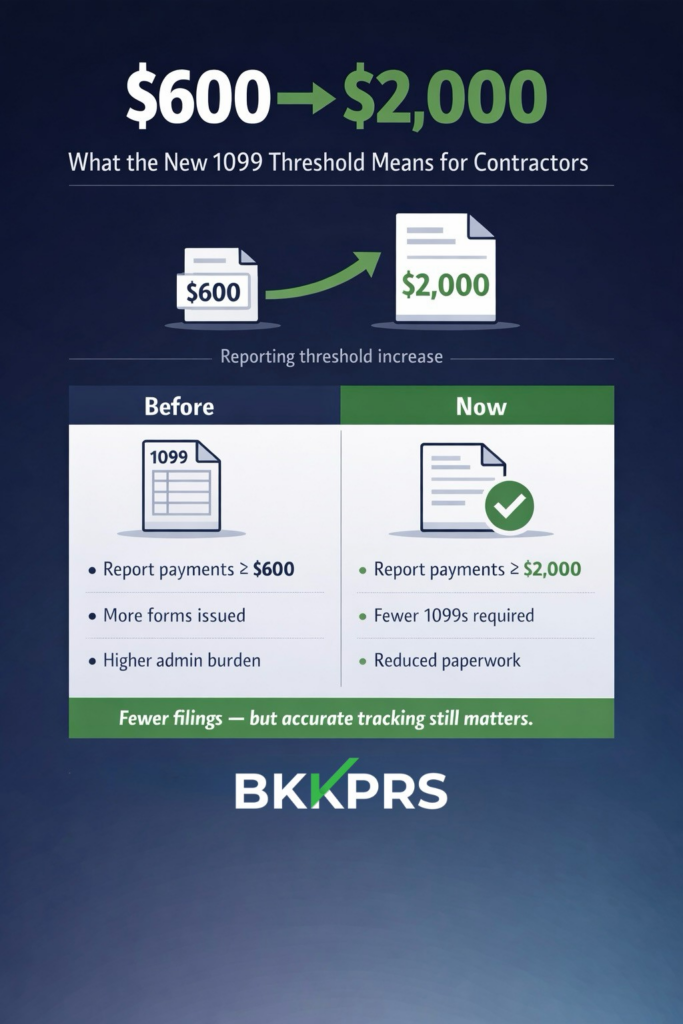
If you’re a contractor who works with subcontractors, you’ve been filing 1099 forms for every sub you pay $600 or more in a calendar year. Starting in 2026, that threshold is jumping from $600 to $2,000 for 1099-NEC and 1099-MISC forms. And it will be adjusted for inflation going forward.
On the surface, this is a welcome simplification. Fewer forms to file. Less administrative burden for smaller payments. But before you celebrate, there’s a nuance worth understanding: the threshold change simplifies reporting, not record-keeping.
The IRS published updated guidance on the reporting threshold changes as part of their OBBBA provisions page at irs.gov/newsroom/one-big-beautiful-bill-provisions.
What Actually Changed
Under the OBBBA, the reporting threshold for payments to independent contractors increased from $600 to $2,000. If you pay a subcontractor less than $2,000 in a calendar year, you’re no longer required to issue a 1099 for that payment.
For contractors who use smaller subs for specialized tasks — a tile guy here, an electrician there — this could meaningfully reduce the number of 1099s you file each January.
But the IRS isn’t suddenly less interested in your subcontractor payments. They’re just adjusting the reporting trigger. The obligation to track all payments, maintain W-9s, and have clean vendor records hasn’t changed at all.
Third-Party Payment Platforms: A Separate Issue
The 1099-K threshold for third-party payment platforms (PayPal, Venmo, Square) has returned to $20,000 and 200 transactions. If you’re paying subs through these platforms, the reporting requirements follow different rules. Make sure your bookkeeping tracks the method of payment so you’re not double-reporting or missing a filing.
DIY: The Subcontractor File Audit
| ✅ THE 30-MINUTE SUB COMPLIANCE CHECK — DO THIS QUARTERLY 1. Pull a report from your accounting software of all payments made to subcontractors and independent contractors year-to-date. 2. For each vendor on the list, verify you have a current W-9 on file. “Current” means: correct legal name, correct TIN/SSN, correct entity type, and signed. If a sub changed their business structure (sole prop to LLC, for example), you need an updated W-9. 3. Check the payment method for each sub. Are you paying by check, ACH, Venmo, Zelle, cash? Each method has different tracking and reporting implications. Cash payments with no documentation are audit red flags. 4. For any sub approaching the $2,000 threshold, flag them now. Don’t wait until January to figure out who needs a 1099. 5. Verify that every payment is coded to the correct expense category in your books (subcontractor expense, not “materials” or “miscellaneous”). This takes 30 minutes quarterly and saves you hours of cleanup (and potential penalties) at year-end. |
The IRS instructions for Form 1099-NEC detail exactly what payments need to be reported and by when. The updated forms for 2026 filings will reflect the new threshold.
The Bottom Line
The new 1099 threshold is a genuinely helpful change for contractors. It reduces paperwork without reducing your tax obligations. Take the win, but don’t let it lull you into sloppy record-keeping.
At BKKPRS, we handle accounts payable, vendor management, and 1099 filing for construction businesses. We keep your records organized year-round so compliance is a non-event, not a January fire drill. If your sub payments are scattered across bank accounts, apps, and check stubs, let’s get that cleaned up.